
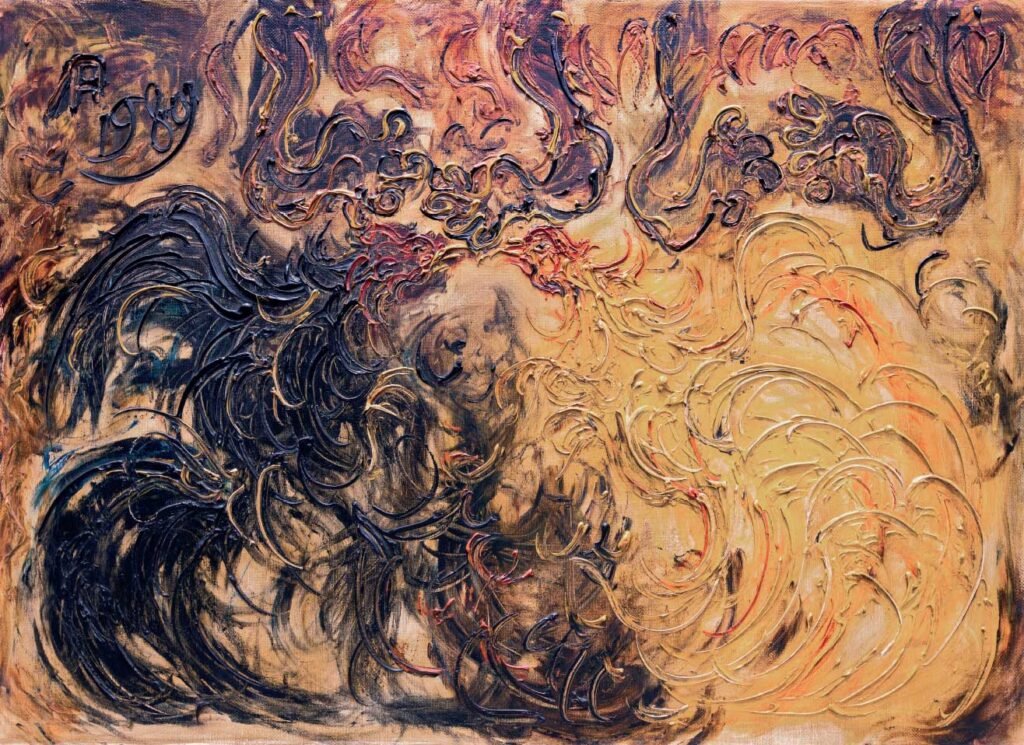
Affandi painted as if no one were watching. His canvases pulse with urgency, paint squeezed straight from the tube, lines formed by instinct rather than calculation, gestures that feel closer to breath than to brushstroke. At first encounter, his work can appear unruly, even chaotic. Forms dissolve, colors collide, and perspective refuses to behave. Yet to stop at that first impression is to miss the essence of Affandi’s practice. His freedom was never careless. It was deliberate, ethical, and deeply human.
Affandi’s approach rejected academic restraint, but not responsibility. He did not paint to shock, nor to decorate. He painted to tell the truth as he felt it: raw, direct, alive. This honesty is what gives his work its power. The seeming disorder on the surface conceals an inner direction, one shaped by empathy, observation, and lived experience. His subjects, ordinary people, laborers, mothers, animals, landscapes are not reduced to aesthetic objects. They remain dignified, vulnerable, and present.
To stay with an Affandi painting is to begin understanding its guidance. The lines lead the eye not through strict composition, but through emotion. The colors do not obey harmony in a conventional sense; they obey feeling. What looks unrestrained is in fact carefully listened to. Affandi allowed the painting to emerge from an encounter between the self and the world, rather than forcing it into predetermined rules. In this sense, his freedom was not the absence of structure, but the presence of attention.
There is an important distinction here: freedom without ethics is merely noise. Unchecked expression can become hollow spectacle, empty provocation. Affandi understood this instinctively. His work is grounded in care, care for his subjects, for the realities they inhabit, and for the act of painting itself. Even at its most intense, his expression never abandons respect. The soul of the work remains intact because it is anchored in responsibility.
This is why Affandi’s art continues to resonate in conversations about progress, creativity, and humanity. In an age that often equates freedom with limitlessness, his practice offers a quieter, wiser lesson. True progress does not mean discarding all boundaries; it means choosing which ones matter. It means allowing intuition to lead, but values to guide.
Affandi shows us that freedom gains meaning only when it is held with care. When expression is guided by empathy and ethics, it does more than break rules, it builds connection. And in that connection, art retains its soul.
That is how progress, in art and beyond, remains deeply human.